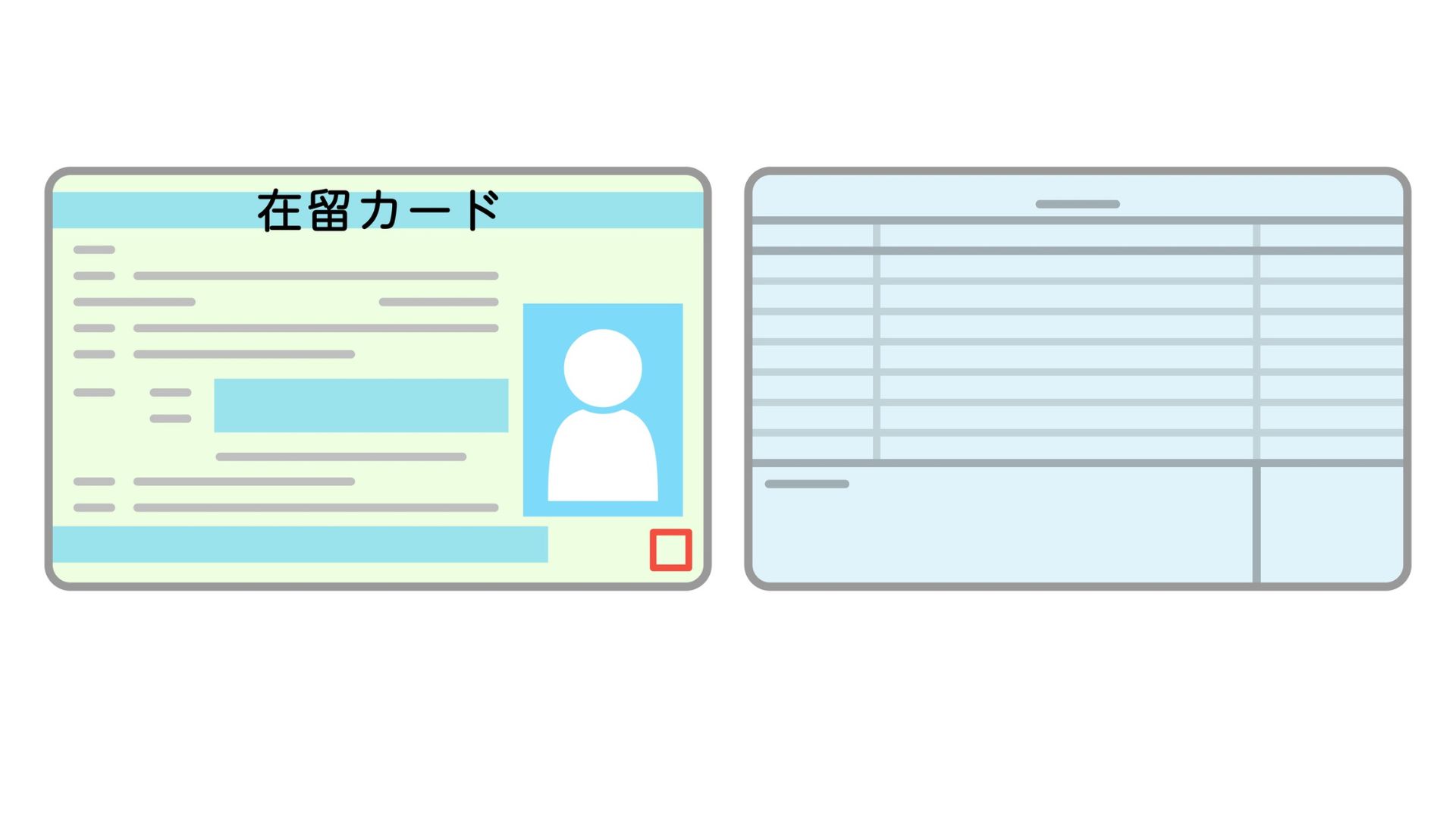
From convenience stores to restaurants, seeing international staff members at work has become part of everyday life in Japan. Yet many business owners and hiring managers still wonder: “We would like to hire a foreign national for a part-time job, but what exactly do we need to check?”
The good news is that there are three essentials. At the right stage of the hiring process, check the employee’s Residence Card for (1) their status of residence and employment restrictions, (2) permission to engage in activities other than those permitted under their status of residence, and (3) their period of stay.
These checks can substantially reduce the risk of unauthorized employment—working without the legal permission to do so. Depending on the person’s status, you may also need to examine a Designation Document or a separate permission certificate.
Why does this matter? Japan’s Immigration Services Agency (ISA) warns that an employer may still be penalized for employing someone illegally, even without knowing their status, if the employer was negligent—for example, by failing to check their Residence Card. Checking is an important way to protect your business.
New Residence Card formats were also introduced in June 2026, so more than one format is currently in circulation. This guide explains when to check documents, the three key items to review, the new cards, penalties, and mandatory employer notifications.
目次
When should you check a Residence Card? After a job offer, before employment begins
Let’s start with the timing, which is often misunderstood: the job interview is not the stage at which you should demand to inspect the physical Residence Card.
To promote fair recruitment and protect applicants’ rights, the Ministry of Health, Labour and Welfare (MHLW) advises employers not to ask about matters such as nationality during interviews. Instead, employment eligibility should be discussed verbally, and employers should request the relevant documents once a hiring decision has been made.
The government’s fair recruitment guidance similarly explains that eligibility may be checked verbally or in writing during selection, while the actual Residence Card should be checked after a job offer.
Requesting the card too early can disclose information, such as nationality, that is unrelated to the applicant’s ability or suitability for the job.
During an interview, you may ask questions such as “Do you have a status of residence that permits this work?” or “Have you received permission to work outside your current status?” After making an offer, but before the person starts work, inspect the original card and check the three items below.
Remember that Residence Cards contain personal information. Handle any information you view or record carefully.
The three essential checks: a quick-reference table
A Residence Card is generally issued to foreign nationals residing in Japan on a medium- or long-term basis. Short-term visitors, such as tourists, do not receive one.
After making a job offer and before the employee begins work, inspect the original card in this order:
Step
What to check
What it tells you
1
Status of residence and employment restrictions
“No work restrictions” means the status does not limit the type of job or industry.
2
Permission to engage in activities outside the status of residence
A person whose card says “Not permitted to work” may still work within the conditions of a separate permission.
3
Expiration of the period of stay
Check the date and, if it is approaching, the progress of any extension application.
Older card formats remain valid until their own expiration dates, so several designs are now in use.
Because the location of information may vary, do not assume a particular item is always on the back. Look for the relevant field on the actual document.
As a general rule, foreign nationals who do not have a Residence Card cannot work, although there are exceptions, including Special Permanent Residents.
Some people may not hold a card—for example, if their passport indicates that a card will be issued later, if their authorized stay is three months or less, or if they hold a “Diplomat” or “Official” status. In such cases, check the passport and other relevant documents to determine whether work is permitted.
A verbal statement such as “I have a visa that lets me work” is not enough. After the job offer and before work begins, inspect the original documents and check what they actually permit.
Check 1: Status of residence and employment restrictions
First, look at the “Status of Residence” and “Employment Restrictions” fields.
If the card says “No work restrictions”, the person’s immigration status does not restrict their occupation or industry. This generally applies to Permanent Residents, Spouses or Children of Japanese Nationals, Spouses or Children of Permanent Residents, and Long-Term Residents.
You must still check the card’s validity and relevant dates. Special Permanent Residents are also not subject to immigration-status-based employment restrictions.
If the card says “Not permitted to work”, employment is generally prohibited unless the person has separate permission for activities outside their status, as explained below.
If the card permits work only within the scope of the status of residence, the job must fall within that authorized scope. For example, a person authorized to work as a language instructor cannot automatically be hired for unrelated factory work.
You must check whether the proposed duties fit the individual’s status. For statuses such as “Designated Activities” or “Specified Skilled Worker,” a Designation Document attached to the passport may be necessary to determine precisely what work is authorized.
Check 2: Permission to work outside the status of residence—not all permissions are the same
A “Not permitted to work” entry does not always mean that part-time work is impossible. Check whether the person has permission to engage in activities other than those permitted under their status of residence.
On older Residence Cards, this is recorded in the “Permission to Engage in Activity Other Than That Permitted” section on the back. The permission allows certain paid activities that the person’s primary status would not otherwise permit, subject to specific conditions.
If the person does not have the necessary permission, they must not perform that work.
Where the permission states “Permitted (in principle, up to 28 hours per week; excluding work in adult-entertainment-related businesses)”, employment is possible within those conditions. This is common for students and people on a Dependent status.
There are three important points about the 28-hour rule:
The 28-hour limit applies to all employers combined, not separately to each part-time job.
Students may work up to eight hours per day during long school vacations officially designated by their educational institution.
This permission is linked to being enrolled as a student. After graduation or otherwise leaving the institution, the person cannot simply continue working on the same basis because the permission still appears on the card.
Some cards instead state “Permitted (within the scope specified in the Permission to Engage in Activity Other Than That Permitted certificate)”. This does not necessarily mean 28 hours per week. Ask to see the separate permission certificate and check the permitted work and validity period.
Another type of permission covers certain activities falling under “Instructor,” “Engineer/Specialist in Humanities/International Services,” or “Skilled Labor,” up to 28 hours per week, in connection with employment by a local public body or similar organization. This is unusual in ordinary part-time recruitment, but the wording and conditions matter.
The exclusion for adult-entertainment-related businesses also covers more than sexually oriented businesses. It can include pachinko parlors, mahjong establishments, and certain amusement arcades regulated under Japan’s adult entertainment business legislation.
Even back-of-house duties, such as cleaning or washing dishes, may be prohibited at such establishments.
Make sure whoever prepares staff schedules understands the 28-hour rule. A person may be eligible when hired, but exceeding the combined weekly limit through additional shifts can result in unauthorized employment.
Check 3: Period of stay—an expired date does not always mean overstaying
Finally, check the expiration date of the person’s authorized period of stay. A person who remains in Japan after that date without a valid legal basis may be overstaying and cannot be employed.
However, an expiration date that has passed does not automatically mean the person is in Japan unlawfully.
If an application to extend or change status was filed before the expiration date, a special extension period may allow the person to remain in Japan and continue activities permitted under the previous status until the application is decided or until two months after the original expiration date, whichever comes first.
For applications filed at an immigration office, check the application-pending notation on the Residence Card. For online applications, review evidence such as the application receipt email containing the application number.
Importantly, the special extension period generally preserves activities allowed under the existing status. Filing an application to change status does not necessarily allow the person to start work permitted only under the proposed new status.
Permanent Residents have an indefinite period of stay, but their physical Residence Cards have an expiration date. Do not confuse the card’s validity with the period of stay.
Do not treat the hiring-stage check as a one-time task. Ask to see the updated card whenever a renewal is completed, and keep track of important dates.
Preventing forged Residence Cards: use the latest official reading app
There is another risk when checking Residence Cards: forged documents.
Some counterfeit cards may use numbers associated with genuine cards, and visual inspection alone may not reveal the problem.
The ISA provides a free Residence Card Reading Application. It reads the card’s IC chip so that the information displayed by the app can be compared with the physical card to help identify possible forgery or alteration.
Use the latest version compatible with the new Residence Card and Specified Residence Card. Certain fields, including the period of stay, type of permission, and permission date, are no longer printed on the new card format; an app update on August 19, 2026 made these details available through the app.
The ISA also provides an online service to check whether a Residence Card number has been invalidated. However, a valid number alone does not prove that a physical card is genuine, so use this service alongside the reading app.
Be careful about retaining copies. Because the back of a Specified Residence Card contains the individual’s My Number (personal identification number), routinely copying both sides may create unnecessary privacy and compliance risks.
A safer approach is to record only the information needed for employment checks, such as the date and person performing the check, status of residence, work restrictions, permission details, period of stay, and card number, while following applicable privacy rules.
Failure to check can lead to penalties for facilitating illegal employment
An employer who allows someone to work illegally may also face criminal penalties.
Under the offence of facilitating illegal employment, an employer or intermediary may be subject to imprisonment for up to three years, a fine of up to JPY 3 million, or both, under the rules described in the source article.
As noted above, the ISA explains that an employer may still be punished even if they did not know the person was working illegally, where negligence—such as failing to check the Residence Card—is involved. The ISA’s guidance for employers also notes possible deportation consequences for foreign-national employers.
An amendment promulgated in June 2024 provides for an increase in the maximum penalty to five years’ imprisonment or a JPY 5 million fine, or both. The source article states that the relevant amendment is scheduled to take effect on April 1, 2027, subject to exceptions for certain provisions.
This reflects the importance of immigration compliance in employing foreign nationals.
The point of discussing penalties is not to alarm employers. Checking immigration documents is one practical way to protect your business. We recommend recording when the check was made, who made it, and what was verified.
After hiring, remember to notify Hello Work
Once you have confirmed eligibility and hired the employee, there is another obligation.
Employers must submit a Notification of Employment Status of Foreign Nationals to Hello Work when hiring or when a covered foreign-national employee leaves. This includes short-term part-time employees. Exceptions include Special Permanent Residents and people holding “Diplomat” or “Official” status.
The reporting deadline depends on whether the employee is covered by employment insurance.
Employment insurance
When hired
When leaving
Covered by employment insurance
By the 10th of the following month
Within 10 days from the day after leaving
Not covered by employment insurance
By the end of the following month
By the end of the following month
Failure to submit the required notification, or filing a false notification, may result in a fine of up to JPY 300,000. A copy of the Residence Card is not required to be submitted to Hello Work for this notification.
Summary: three checks before hiring a foreign national for part-time work
Here are the key takeaways:
Check the original Residence Card after making a job offer but before employment begins. At the interview stage, use verbal eligibility questions.
Check 1: Status of residence and employment restrictions. “No work restrictions” means the immigration status does not restrict the type of work.
Check 2: Permission to work outside the status. The common limit is 28 hours per week across all employers, but other types of permission have different conditions.
Check 3: Period of stay. An expired date may be covered by a special extension period if a timely extension or change application is pending. Verify the application evidence.
New Residence Card formats were introduced in June 2026. Use the latest official card-reading app to help detect forgery.
Negligent checks may expose employers to penalties for facilitating illegal employment; the source article describes a penalty increase scheduled for April 2027.
After hiring, submit the required foreign-national employment notification to Hello Work, including for part-time staff.
Once you know the three basics, the checks can often be completed in a few minutes. Still, the details of Designation Documents, separate permissions, and special extension periods can be confusing.
Our office provides support in Japanese, English, and Chinese. We assist employers with checking work eligibility, understanding immigration statuses, and preparing immigration applications. We would be happy to help you plan the next steps.
About the Author Megumi Suzuki, Certified Administrative Scrivener (Gyoseishoshi). After studying at universities in Japan and Shanghai, she worked as an international flight attendant for approximately 12 years. Through meeting people from around the world, she became passionate about supporting those who wish to study, work, and build their futures in Japan. She now specializes in immigration applications and support for foreign nationals. Guided by the motto “Supporting you beyond the moment you step off the plane”, she values each client’s past, present, and future and provides thoughtful, personalized assistance.
Wondering whether your question is too small to ask? Please feel free to reach out. We are happy to help.